
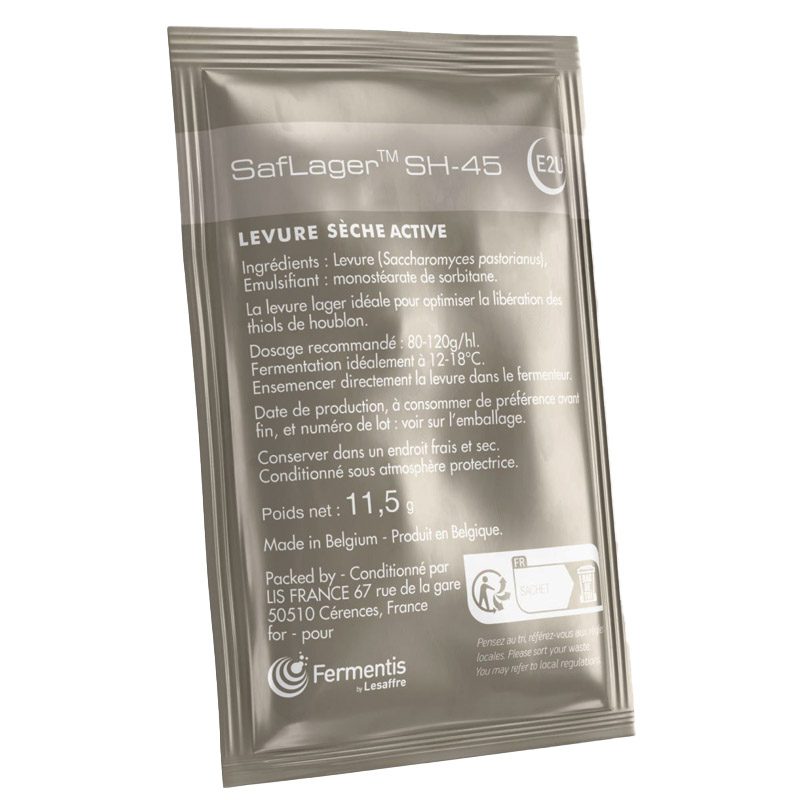

Description
Biotransformation
A growing trend in brewing, biotransformation occurs when yeast-derived enzymes convert odorless and flavorless precursors into desirable flavors and aromas. Certain yeasts, like SafLager™ SH-45, facilitate hop biotransformation, which unlocks new aromas that hops can’t achieve on their own during fermentation.
There are two families of compounds in hops that can be released – thiols (more fruity) and terpenes (more floral). Precursors in the hops are linked to another compound: cysteine (cys-thiol or cys-adduct) or glutathione (G-thiol or GSH-adduct). GSH-thiols are much more present in hops than cys-thiols. When linked or bound, these precursors are unperceivable. Certain yeasts, however, like SafLager™ SH-45, have the ability to break these links coming from GSH-adducts and set free the thiols, producing desirable flavors and aromas in the beer. In addition, and remarkably, SafLager™ SH-45 has a good ability to esterify these freed thiols into volatiles that are even more aromatic.
Laboratory Trials
To gain a better understanding of SafLager™ SH-45 biotransformation capabilities, lab trials were conducted with synthetic thiols. Cyc-adduct and GSH-adduct precursors were fermented using different Fermentis yeasts in unhopped wort under various conditions to compare the thiol extraction and concentration.
SafLager™ SH-45 showed a remarkably higher potential to release bound thiols and esterify the alcoholic form from GSH precursors. SafLager™ SH-45 released the highest amount of 3SHol (3MH) and 3SHA (3MHA) esters from GSH-thiols.
Hop to it!
Certain hop varieties will contain more or less free thiols. So, for the best results, which hops should brewers be using? Trials were conducted to monitor the release of 3SHOL ester [guava, citrus] and 3SHA [passionfruit, grapefruit] from free precursors (3MH and 3MHA respectively).
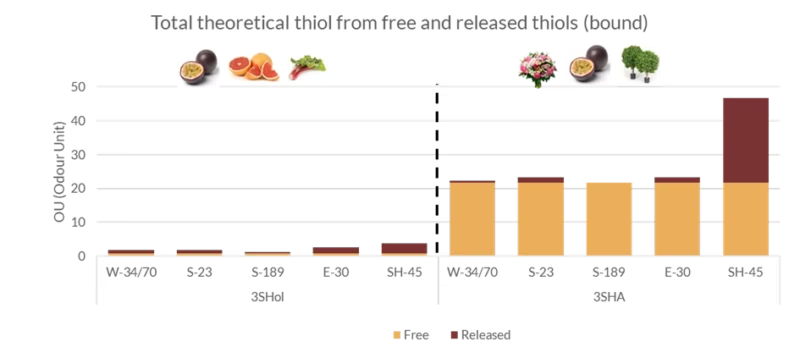
^ Total Thiol: Free vs Released – CITRA HOPS
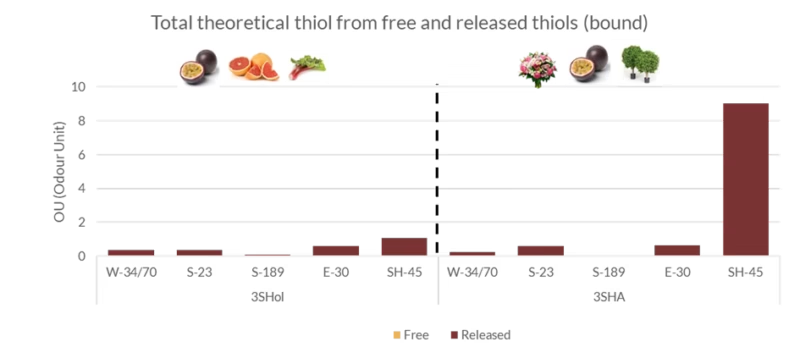
^ Total Thiol: Free vs Released – AMARILLO HOPS








There are no reviews yet.